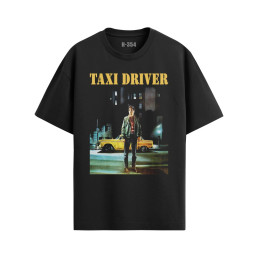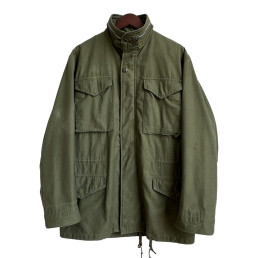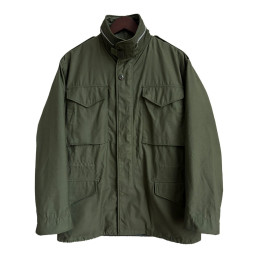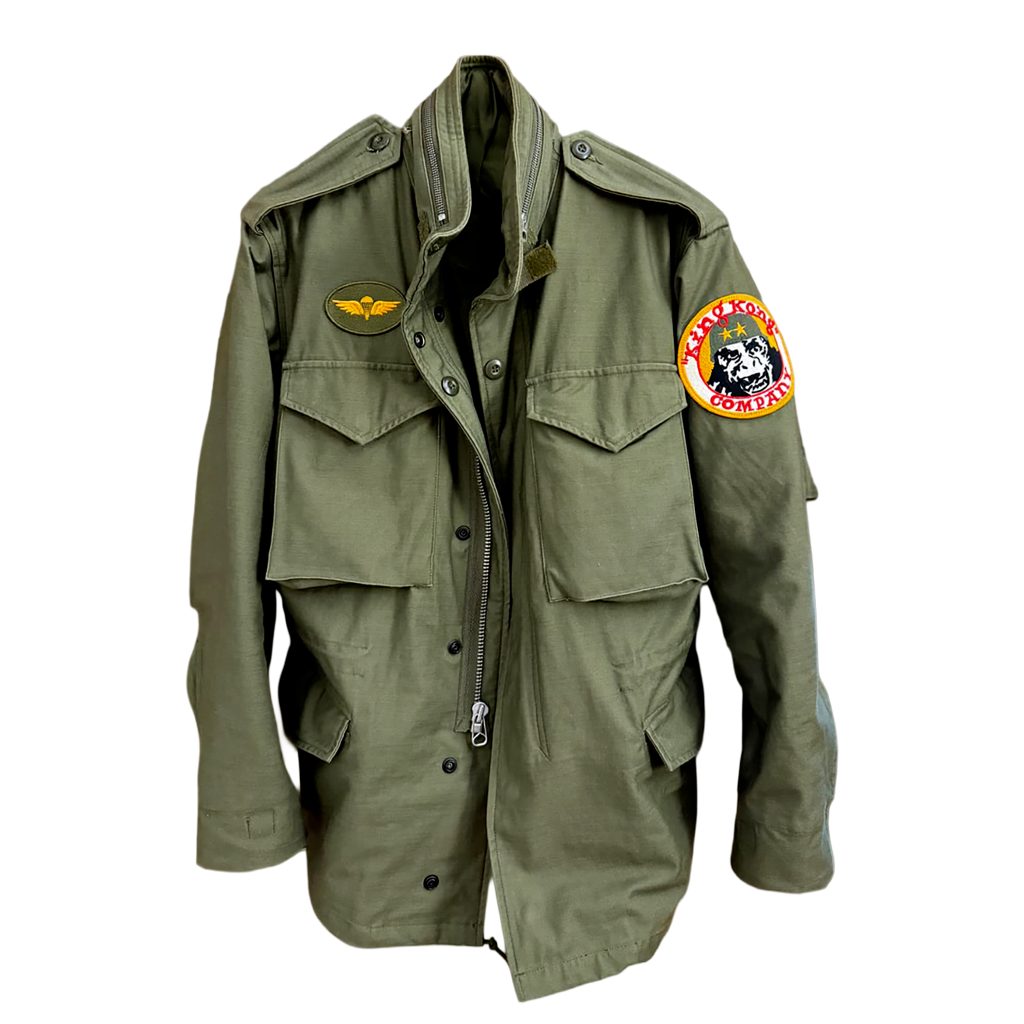
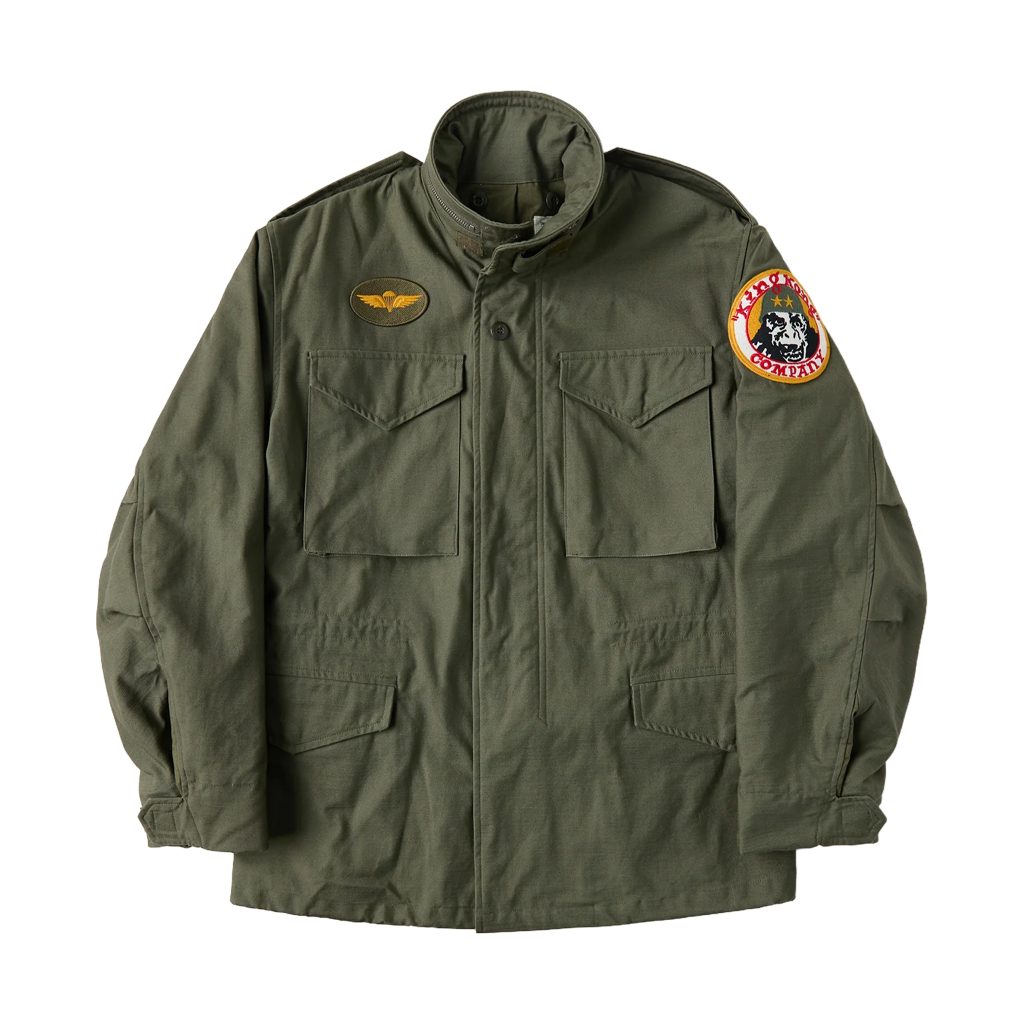
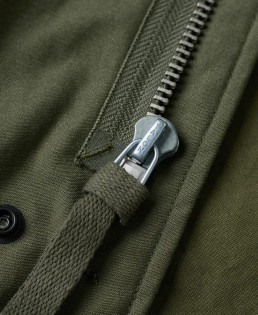
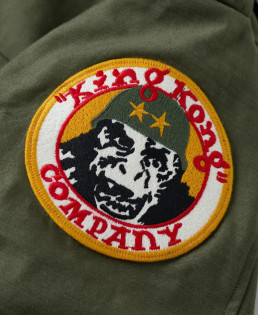
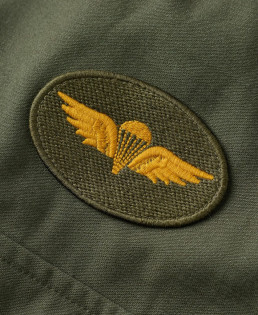
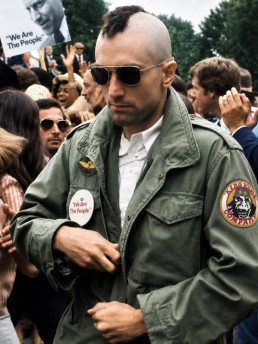
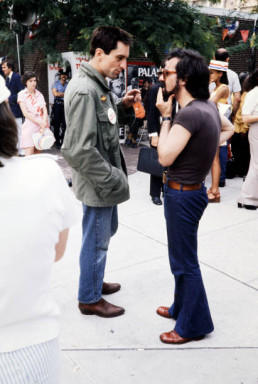
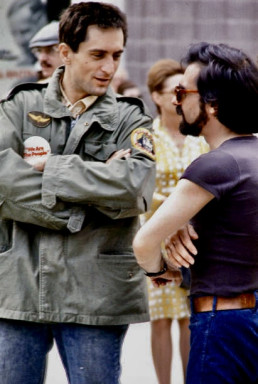
This Bronson Mfg. Co. jacket is a reproduction of the 1969-era M-65 Field Jacket, Second Pattern, recreated with details associated with the early Vietnam-era configuration. It features a “KING KONG COMPANY” embroidered patch on the left sleeve and a parachutist qualification badge on the right chest, reproducing the distinctive appearance of the jacket worn by Robert De Niro as Travis Bickle in Taxi Driver (1976). The original jacket seen in the film features an aluminum front zipper, consistent with early M-65 production of the late 1960s.
The reproduction is constructed from 12.2 oz. custom nylon-cotton sateen, giving the jacket a substantial hand and resistance to wind. Its early OG-107-inspired coloration follows the appearance of Vietnam-era M-65 field coats, while the nylon-cotton construction provides greater durability and faster drying than an equivalent garment made entirely from cotton.
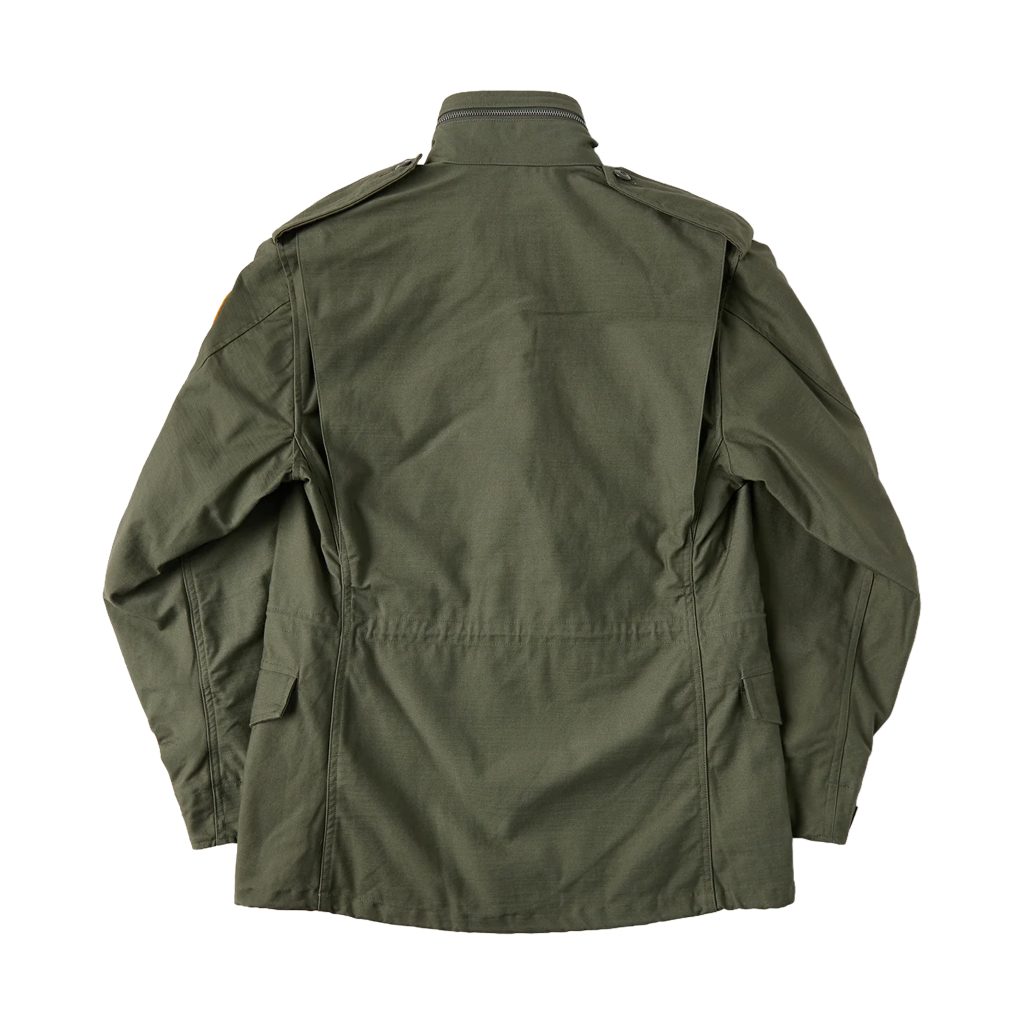
The M-65 developed from the earlier U.S. Army field coat systems, including the M-41, M-43, and M-51. Its familiar four-pocket arrangement evolved from these earlier designs, while the M-65 introduced a number of refinements for improved field use. An internal waist drawcord reduces the risk of external snagging, while the adjustable sleeve cuffs and articulated construction provide additional protection and mobility.
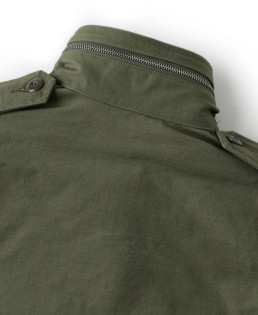
Shoulder epaulets are retained as part of the Second Pattern appearance and historically provided a location for insignia. Pleated construction across the back and articulated sleeves allow greater freedom of movement, while the adjustable waist helps control the jacket’s overall fit.
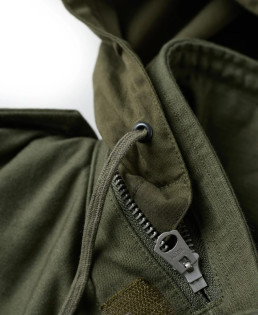
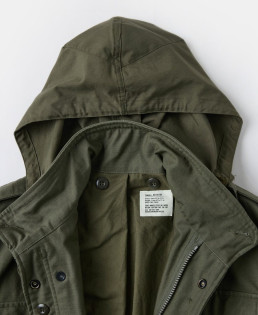
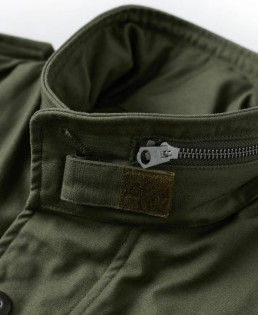
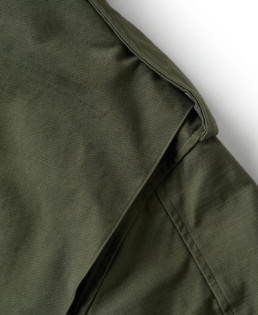
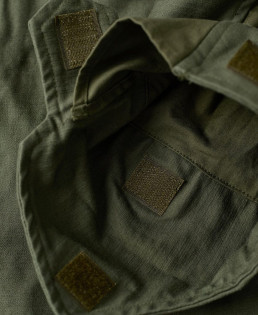
The stand collar incorporates a zippered compartment containing the concealed hood, one of the M-65’s most recognizable functional features. The reproduction also includes an open interior hem construction and a fit that has been refined from the original military pattern for a somewhat more contemporary silhouette.
Overall, the jacket combines the construction details and visual character of the late-1960s M-65 with a modern reproduction fit, making it particularly recognizable to those familiar with Travis Bickle’s appearance in Taxi Driver.
FILM REFERENCE
TITLE: TAXI DRIVER
RELEASE YEAR: 1976
RELEASE DATE: FEBRUARY 7, 1976
DIRECTOR: MARTIN SCORSESE
WRITER: PAUL SCHRADER
PRODUCERS: MICHAEL PHILLIPS · JULIA PHILLIPS
CINEMATOGRAPHY: MICHAEL CHAPMAN
EDITING: TOM ROLF · MELVIN SHAPIRO
PRODUCTION DESIGN: CHARLES ROSEN
MUSIC: BERNARD HERRMANN
PRODUCTION COMPANIES: BILL/PHILLIPS PRODUCTIONS · ITALO-JUDEO
DISTRIBUTION: COLUMBIA PICTURES
GENRE: DRAMA · CRIME
CAST
ROBERT DE NIRO — Travis Bickle
JODIE FOSTER — Iris
CYBILL SHEPHERD — Betsy
HARVEY KEITEL — Sport
PETER BOYLE — Wizard
ALBERT BROOKS — Tom
LEONARD HARRIS — Senator Charles Palantine
JOE SPINELL — Personnel Officer
MARTIN SCORSESE — Passenger
STEVEN PRINCE — Easy Andy
DETAILS
THE STORY
Taxi Driver (1976) follows Travis Bickle, a 26-year-old former Marine who works long night shifts as a New York City taxi driver. Unable to sleep and increasingly alienated from the city around him, Travis begins recording his thoughts in a diary while developing an obsessive belief that New York has become corrupt and needs to be cleansed.
His isolation deepens after an unsuccessful relationship with Betsy, a campaign worker for presidential candidate Charles Palantine. At the same time, Travis becomes increasingly preoccupied with violence, weapons, and his own sense of purpose. He begins training with firearms and gradually transforms his appearance, adopting the distinctive mohawk that marks his final descent into violence.
The M-65 field jacket becomes an important part of this transformation. Originally developed as U.S. military field clothing, the jacket gives Travis a distinctly military and utilitarian appearance, reinforcing the character’s connection to his Marine background and his increasingly militarized worldview.
Travis eventually decides to assassinate Palantine, but the attempt fails when Secret Service agents recognize him before he can reach the candidate. He then redirects his violence toward the world surrounding Iris, a teenage prostitute whom he has previously tried to persuade to leave her life with her pimp, Sport.
The resulting confrontation leaves Travis severely wounded. After the violence, the newspapers portray him as a hero for rescuing Iris, creating one of the film’s central ironies: a deeply disturbed and violent man is transformed by the media into a public hero.
By the end of the film, Travis has returned to work as a taxi driver. He encounters Betsy again as a passenger, but their brief meeting is distant and awkward. Travis drives away into the city, apparently continuing the same existence that began the film.
The M-65 therefore functions as more than simply a military-style jacket in Taxi Driver. Combined with Travis’s mohawk, weapons, and increasingly rigid worldview, it forms part of the visual transformation of an isolated former Marine into one of American cinema’s most recognizable antiheroes.
TRIVIA & BEHIND THE SCENES
The M-65 Became Part of Travis Bickle’s Identity
Travis Bickle’s military-style appearance is one of the most recognizable visual elements of Taxi Driver. Costume designer Ruth Morley used an M-65 field jacket, aviator sunglasses, and the distinctive mohawk to create Bickle’s increasingly militaristic appearance as the character descends into violence.
Robert De Niro Prepared by Driving a Taxi
To prepare for the role, Robert De Niro actually worked as a taxi driver for approximately a month before filming. AFI records that he drove a cab in preparation for the role, and one magazine writer later discovered that De Niro had unknowingly driven him as a passenger during this preparation period.
The Mohawk
The mohawk was not simply a spontaneous styling choice. De Niro later explained that he and Martin Scorsese developed the look after being shown photographs by a friend of Scorsese who had been involved with Special Forces. The hairstyle became one of the defining visual markers of Bickle’s transformation.
The Mirror Scene
The famous scene in which Bickle practices drawing his weapons in front of a mirror was largely developed during production. According to Scorsese, De Niro improvised the scene and created the famous confrontation with his own reflection.
The screenplay described the basic situation, but the final performance was developed by Scorsese and De Niro on set.
Filmed on the Streets of New York
Unlike many productions that recreate New York elsewhere, Taxi Driver was filmed in New York City, with principal photography taking place from approximately mid-June through mid-August 1975. The city’s streets, nightlife, storefronts, taxis, and deteriorating urban environment became an essential part of the film’s atmosphere.
The Heat of the Summer Shoot
The production took place during the New York summer, and the heat became a practical problem for the cast and crew. Cybill Shepherd recalled that the weather was extremely hot during filming, including the removal of air conditioning during the shooting of the diner date scene so that the sound equipment could operate properly.
Jodie Foster Was Thirteen
Jodie Foster was only thirteen when she was cast as Iris. Because of the film’s subject matter, she underwent psychological testing before being allowed to take the role. AFI also records that her older sister Connie served as a stand-in for certain provocative actions that were considered inappropriate for the young actress.
Martin Scorsese Appears in the Film
Martin Scorsese makes a brief but memorable appearance as the passenger who sits in Travis’s cab outside an apartment. The actor originally cast in the role left the production after an accident, so Scorsese ultimately took the part himself.
Bernard Herrmann’s Final Score
The score was composed by legendary film composer Bernard Herrmann, whose earlier work included Citizen Kane, Vertigo, Psycho, and other landmark films.
Taxi Driver became Herrmann’s final film score. He completed the recording sessions in December 1975 and died on December 24, 1975, only hours after finishing the sessions.
Steve Schapiro Documented the Production
The production was extensively photographed by Steve Schapiro, who is credited by AFI as the film’s special photographer. His photographs provide some of the most recognizable behind-the-scenes documentation of Robert De Niro as Travis Bickle, including the character’s military-inspired appearance.
A Low-Budget Production
The filmmakers had difficulty securing financing for the project and ultimately produced the film on a relatively tight budget. Despite the financial limitations, Schrader, Scorsese, De Niro, and the producers remained committed to making the film according to their original vision.
CARE
• Machine wash cold, inside out.
• Do not bleach.
• Wash separate.
IMPORTANT
This is a modern Bronson Mfg. Co. reproduction, not an original 1969 U.S. military-issued M-65 Field Jacket.
The design is based on the Second Pattern M-65 configuration of the late 1960s and incorporates details inspired by the jacket worn by Robert De Niro as Travis Bickle in Taxi Driver (1976).